
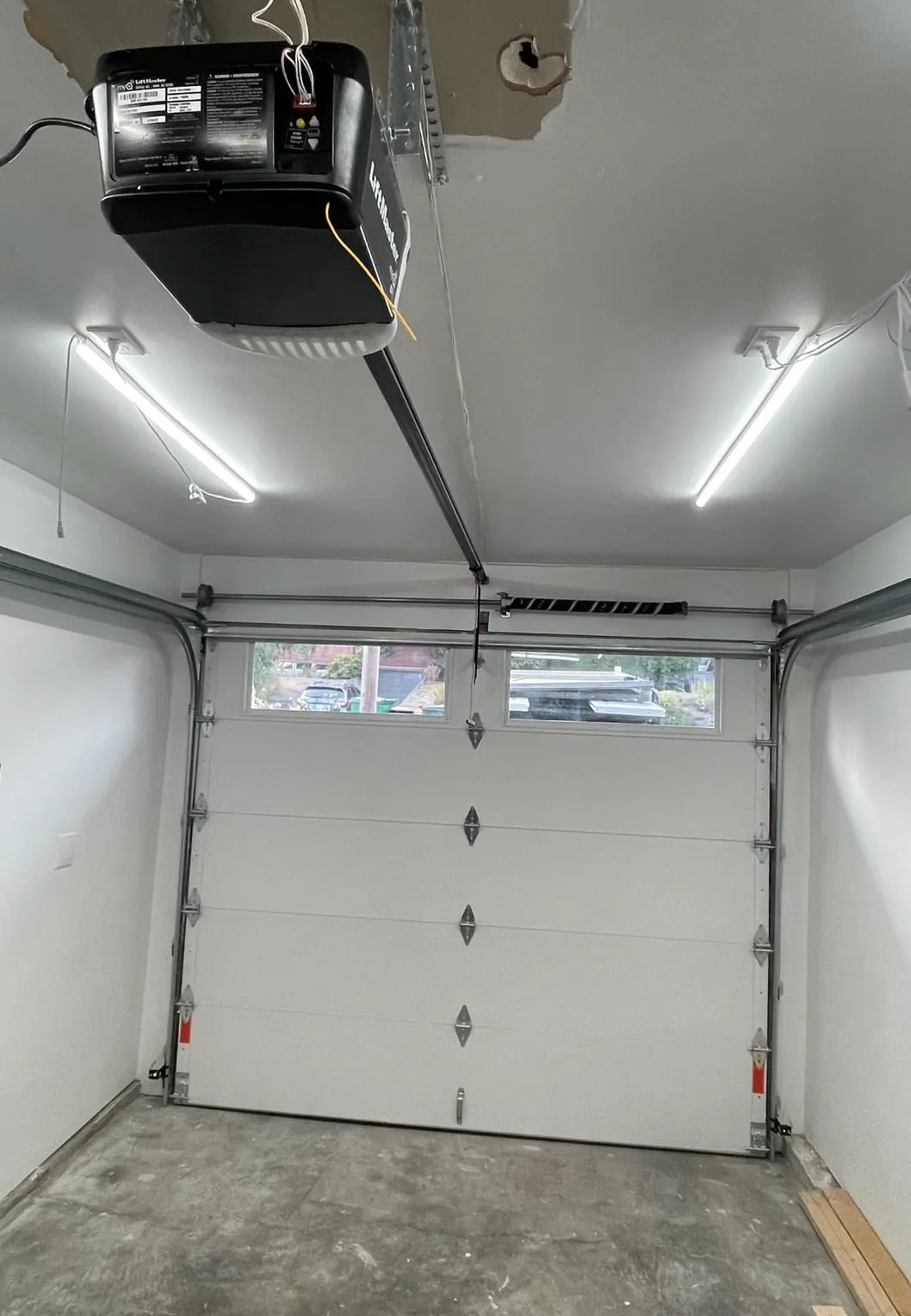
You hit the button on the wall and the opener groans before it moves. Or the light blinks three times and nothing happens at all. Or the door jerks halfway up, stalls, and you have to hold the button down just to get it the rest of the way. You stand there in the heat with the garage door half open, running the math in your head: is this a quick fix, or is the whole unit on its way out?
What's Actually Wearing Out
Garage door openers fail in a handful of predictable ways, and the symptom usually tells you which camp you're in:
- Stripped drive gear — a plastic gear inside the motor housing wears down over years of use. The motor hums but the trolley doesn't move. This is a straightforward, affordable repair.
- Worn chain or belt — sagging, slipping, or a door that drifts off its mark. Also a simple fix on most units.
- Failing capacitor or circuit board — intermittent operation, random reversing, or the opener working only sometimes. Humidity and heat cycling are hard on these components, and once the board starts going, it tends to keep going.
- Dying remote or keypad signal — short range, dropped connections, or a remote that's stopped syncing. Sometimes it's the remote; sometimes the receiver inside the opener is aging out.
- Motor noise that's gotten louder over months — bearings wearing down. Usually means the whole motor unit is approaching the end of its life, even if it still runs.
The first three are often worth repairing. The last two, especially together, are where replacement starts to make more sense.
Repair: What It Costs and What It Buys You
Opener repairs typically run in the $150–$350 range for parts and labor, depending on what's failed. A new gear kit, chain tensioner, or logic board swap can restore full function to an opener that's otherwise sound. If the unit is under 7–8 years old and the housing, motor, and rail are in good shape, repair is usually the cheaper path in year one.
What repair doesn't buy you: it doesn't upgrade an underpowered motor straining against a heavier insulated door, it doesn't add battery backup for power outages during storm season, and it doesn't fix a unit that's simply reached the end of its duty cycle. You're also gambling that the next failure is a year away, not a month away.
Replacement: What It Costs and What It Buys You
A new opener installed typically runs $350–$700 for a standard chain-drive unit, and $450–$900 for a belt-drive model with battery backup and smart connectivity. That's a bigger number upfront, but it resets the clock — most new openers carry warranties covering the motor for 5–10 years or more.
The real value for homes here isn't the quiet belt drive, though that's nice. It's battery backup. When storms knock out power, a battery-backup opener still lets you get the car out or in. It's also worth matching opener horsepower to your actual door: heavier insulated doors, which hold up better against wind-load requirements and swings in humidity, need a motor rated to handle that weight without straining — a mismatch is often why an older opener burns out early in the first place.
The Five-Year Math
Lay it side by side and the pattern is usually this:
- Repair now, repair again in 2–3 years: $150–$350 today, another $150–$350 later, often followed by a third failure as the unit crosses 10–12 years old. Total over five years: commonly $300–$700, plus the inconvenience of repeat service calls and no storm-outage backup.
- Replace now: $350–$900 once, covered by warranty for most of that five-year window, with battery backup and a motor sized correctly for the door. Total over five years: the upfront number, little else.
If the opener is already past 10 years old, has had one prior repair, or shows more than one symptom from the list above, the second repair almost always costs more in total than replacing now — you're just paying it in installments with more downtime in between.
The Trade-Offs, Plainly
Repair wins when the opener is young, the failure is a single isolated part, and you want to delay the expense. Replacement wins when the unit is older, you've already repaired it once, you want battery backup for storm season, or your door itself is heavier or newer than the opener was ever sized to handle. The honest trade-off is cash flow now versus reliability later — and in a climate where losing opener function during a storm isn't just inconvenient, it can mean a door you can't close by hand quickly before wind-driven rain gets into the garage.
When to Call Homestead Garage Door
If you're hearing grinding, seeing inconsistent movement, or you've already had one repair and it's acting up again, that's the point to get an honest second opinion rather than guessing. We'll check the motor, gears, and board, tell you straight whether a repair will hold or whether you're better off with a new unit, and if replacement makes sense, our Garage Door Opener Installation service includes sizing the motor correctly to your actual door. We also recommend a Garage Door Maintenance & Tune-Up either way — a lot of opener strain traces back to a door that's out of balance or dragging on worn rollers, which no amount of opener replacement will fix on its own.
If your opener in Homestead, FL is acting up, call Homestead Garage Door before it fails on you during the next storm. We'll give you a straight answer on repair versus replacement, not just a sale.